
The 5 Solar Energy Myths Costing New Zealand Homeowners Thousands
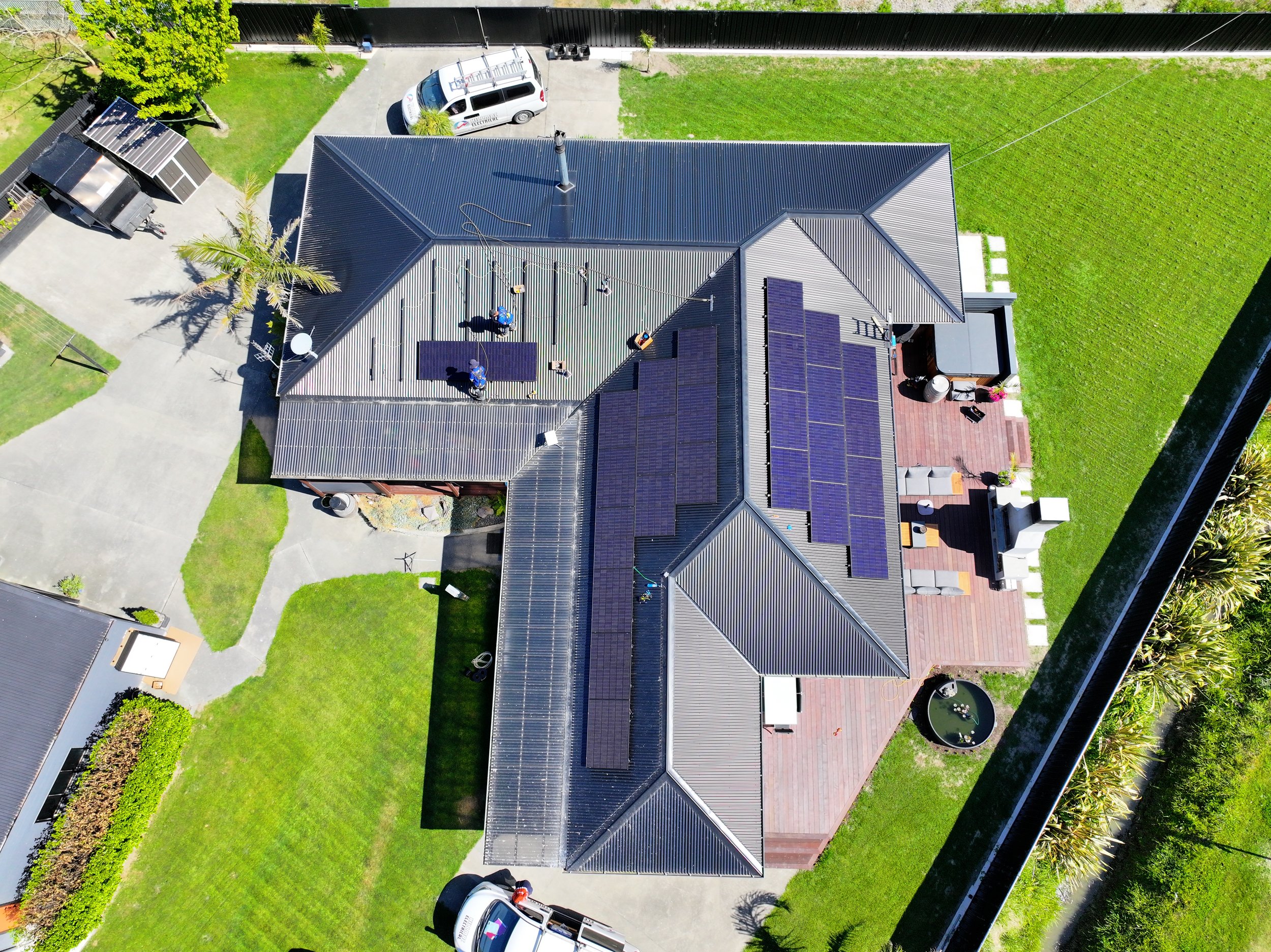
The Investment Power Companies Don't Want You Making
You will spend roughly $15,000–$20,000 more on electricity over the next decade than you did over the last. Here's the the thing, even if electricity generation became completely free tomorrow, your power bill would only fall by 40-50%.
Around half of what you pay isn't for electricity generation - it's for the poles, wires, and substations that deliver power to your home. These transmission and distribution costs are rising as New Zealand's network requires significant upgrades to handle increased demand from EVs, heat pumps, and general electrification.
This means waiting for breakthrough generation technology - whether that's better solar panels, nuclear power, or anything else - won't meaningfully reduce your household electricity costs. The network charges you pay are unavoidable and increasing regardless of how electricity is generated.
While you're reading articles, like this one, about whether solar makes sense yet, Genesis, Mercury, and Contact aren't debating. Hundreds of millions of dollars are flowing into solar farms across New Zealand right now. These are not experimental projects but massive, profit-driven solar installations. These companies have better market data than anyone, and they've done the math. Solar is one of the best investments available in New Zealand's energy market.
They're building these farms with money from your power bill. Then they'll charge you retail rates to use the electricity those farms generate.
You're already paying for solar, why not make it your own?
Five Myths Keeping Homeowners on the Sidelines
So why are households still waiting while power companies are building as fast as they can get consent?
Five myths that sound sensible but quietly cost money every quarter you believe them:
Table of Contents
Myth 1: The numbers don't add up
We’re going to tackle two myths in one. Many homeowners see solar as either prohibitively expensive or, thanks to overly optimistic marketing, a magic bullet that instantly solves all energy costs. Like most topics, the truth sits somewhere in the middle.
Solar Finances Simplified
The simplest way to think about solar is like this:
Power from the grid: 20-40c per kWh
Power from your solar panels: 7-13c per kWh *
Simply put, this means that any power that you consume from your system is 36-67% cheaper than what the network can supply.
The best way to think about solar is not as a cost-saving exercise, but as an investment hedge. Solar is simply a bet that the cost of energy will either continue to trend upward or, worst case, never drop below 7-13c per kWh. Is this a smart bet? Who knows, but for solar to not make sense, the cost of energy would need to decrease by 30-70%. This would require a shift in energy policy, economics, and supply that has never been seen.
*Source: Rewiring Aotearoa - this number factors in things like loan repayments, lifetime costs, and maintenance.
Myth 2: I should wait - solar panels will get better and cheaper
Solar panel efficiency has improved dramatically over the past 15 years, but those gains are slowing. Modern residential solar panels convert 22-24% of sunlight into electricity. In five years, that might be 26–28%. Waiting for that 2-4% gain means giving up five years of generation.
The opportunity cost:
Say you wait two years for panels that are 15% more efficient. During those two years:
You pay approximately $4,000–$6,000 to the grid for electricity you could have generated
Retail electricity prices rise by an average of 3–5% annually, increasing your baseline costs
To break even on waiting, those future panels would need to be dramatically cheaper or more efficient—not 15% better, but enough better to offset $4,000–$6,000 in foregone savings plus the higher retail prices you'll be avoiding in the future.
This almost never works out. Small improvements in panel efficiency don't make up for years of inaction when the technology is already mature and cost-effective.
The best time to install solar was five years ago. The second-best time is now.
Myth 3: I need a big battery system to make solar worthwhile
Home battery systems are often marketed as money-making tools where you can store cheap power, sell it back during peak times, and arbitrage the market. In reality, the payback period on batteries as a purely financial investment is pretty average. You're not going to make your money back trading electricity like this.
Batteries do have a role, but it's about resilience, not revenue.
If you need backup power for medical equipment, live rural with frequent outages, or want peace of mind during storms, batteries serve a purpose. But don't buy them expecting financial returns through grid arbitrage.
Here's what most people miss: if you're considering a battery for resilience, you might already own something better.
The big four household expenses - housing, food, energy, and transport - account for roughly 60% of what you spend each year.
Of these four, energy costs are rising the fastest. Over the past decade, electricity prices have increased roughly 4x faster than mortgage or rent costs, and 1.5x faster than rates. Transport costs aren't far behind, climbing steadily as fuel prices fluctuate.
For most households, energy and transport combined represent $8,000–$12,000 per year. After housing, these are two of the largest line items in any family budget.
If you own or are considering an electric vehicle, you can address both of these expenses with a single decision - while simultaneously solving the battery question.
If you're reading this, there's a good chance you're already thinking about EVs or you already own one. That puts you ahead of most households in recognizing where energy and transport costs are heading.
Here's what most people don't realize: you're probably sitting on, or about to purchase, a battery that's larger and cheaper than a traditional home battery system.
Look at the capacity comparison:
Typical home battery: 10kWh usable capacity, $8,000-10,000 → $800-$1,000 per kWh
Mid-range EV (MG ZS EV, Nissan Leaf): ~60 kWh usable capacity, ~$40,000 new off the lot → $667 per kWh
Second-hand EV (pre-2016 Nissan leaf): 18-20kWh useable capacity, $3,000-$6,000 → $150-$300 per kWh
Around 122,000 New Zealand households now own EVs, and EVs represent over 10% of new vehicle registrations.
If you're in this group (or considering joining it), adding solar connects two of your fastest-rising household expenses:
Charge your EV from solar during the day
Use your EV for backup power
So the question isn't really "Do I need to spend $10,000 on a battery?"
The question is: "Do I already have, or am I about to buy, a vehicle that solves this problem?"
If you have or are planning to get an EV anyway, solar makes that investment dramatically more valuable by giving you absurdly cheap fuel and functional home energy storage.
For households who see where transport and energy costs are heading, solar + EV delivers the resilience benefits of solar + stationary battery, while avoiding $8,000–$10,000 in additional costs and simultaneously hedging against two of your largest and fastest-rising household expenses.
Myth 4: Without a full backup system, I'm not really energy resilient
Energy resilience has become synonymous with "whole-home backup," which is expensive and often overkill for what most households actually need.
The reality of power outages in New Zealand:
Most outages last 2–4 hours
Extended outages (12+ hours) are rare and usually weather-related
During outages, households typically need: refrigeration, lighting, phone charging, and communication
What solar + EV can do without expensive battery systems:
A household with a well sized solar system and an EV can:
Run essential loads (fridge, lights, WiFi, phone charging, and some cooking appliances)
Recharge the EV the following day if the sun is out
Maintain critical resilience for most realistic outage scenarios
This isn't whole-home backup. You're not running heat pumps, ovens, and dryers. But for most families, this covers the essential 80% of what matters during an outage.
Full backup systems are valuable for specific cases: medical equipment, rural properties with frequent outages, or households that want absolute continuity. But they're not the only path to meaningful resilience, and confusing "meaningful" with "total" keeps people from taking practical steps.
Myth 5: New technology or government policy will make solar cheaper - I'll wait for clarity!
The assumption is that waiting reduces risk: solar will get cheaper, batteries will improve, the government might subsidize systems, or grid prices might stabilize. But this misses something: waiting is not neutral. It's a decision with compounding costs.
What the market is telling us:
Electricity in New Zealand is traded like any commodity - listed on the ASX and purchased up to five years in advance. This futures market reveals what large buyers actually expect to pay for electricity, not what politicians promise.
The government announced major energy reforms in October 2025, positioned as measures to address affordability and protect consumers.
The futures market's response? Nothing. Prices continued their trajectory as if the policy changes didn't exist.
If you need more evidence, just look at the share price of all the major Gentailers. Meridian, Contact, Genesis and Mercury all saw their share price increase by an average of nearly 5% after the new regulations were announced.
When the people betting real money on energy prices don't adjust their expectations after "consumer protection" reforms, it tells you what they really think about those reforms' ability to reduce costs.
This isn't new. When it comes to electricity prices, government policy has consistently failed to deliver lower household costs—regardless of which party is in power or what the stated intentions are.
Decades of interventions, regulations, and reviews have coincided with one consistent outcome: higher retail electricity prices for New Zealand households.
Why future improvements won't rescue delayed decisions:
Around 50% of your electricity bill is transmission and distribution - poles, wires, substations, transformers. These costs are rising because:
New Zealand's electricity network requires significant upgrades to handle increased demand
Electrification of transport and heating is adding load
Network maintenance and resilience improvements are expensive and ongoing
Even if solar panels become 20% cheaper or 30% more efficient, your retail electricity price won't fall proportionally because generation is a shrinking portion of the cost structure. The network charges you pay are largely unavoidable and increasing.
This means:
Retail electricity prices have a structural floor that future technology can't breach
Each year you delay, you pay more to the grid
The electricity you could have generated is gone—you can't recover it retroactively
The futures market, the structural network costs, and decades of policy outcomes all point in the same direction: electricity will cost more, not less.
Waiting for the "perfect" moment or for government intervention to solve the problem is a trap. The compounding cost of inaction almost always exceeds the marginal benefit of future improvements.
What this means for you
These myths encourage inaction by making waiting seem sensible. The assumptions that made "wait and see" reasonable no longer hold.
What's different now:
Solar is already cost-effective. Efficiency gains are incremental; the technology is mature.
Network costs are structural. Future improvements in generation won't meaningfully reduce your bills.
EVs change the solar equation. If you own or are planning to own an EV, solar economics improve dramatically - often without needing expensive stationary batteries.
Practical backup for real-world scenarios is achievable.
Inaction has a price. Every quarter you remain fully grid-dependent costs you money that compounds over time.
The real question about solar for your home
The question isn't whether solar, batteries, or EVs are "worth it" in the abstract. It's whether your specific situation - your electricity usage, roof space, vehicle plans, and resilience needs - makes partial energy independence a sensible hedge against rising grid costs.
For many New Zealand households, the answer is yes. And for most of those households, the optimal time to act was years ago. The second-best time is now.
Ready to see what solar looks like for you?